



LTK Kinase Enzyme Activity Assay Kit
The LTK Kinase Enzyme Activity Assay Kit offers a validated, ready-to-use biochemical assay based on the renowned ADP Hunter™ Plus Assay platform from DiscoverX for accurately measuring kinase inhibitor efficacy. The kit includes recombinant LTK, substrate, ATP, detection reagents, and assay plates, enabling precise quantification of ADP accumulation. Designed to handle elevated ATP concentrations, this assay delivers robust, reliable data ideal for high-throughput screening (HTS) and other drug discovery applications.
Biological information
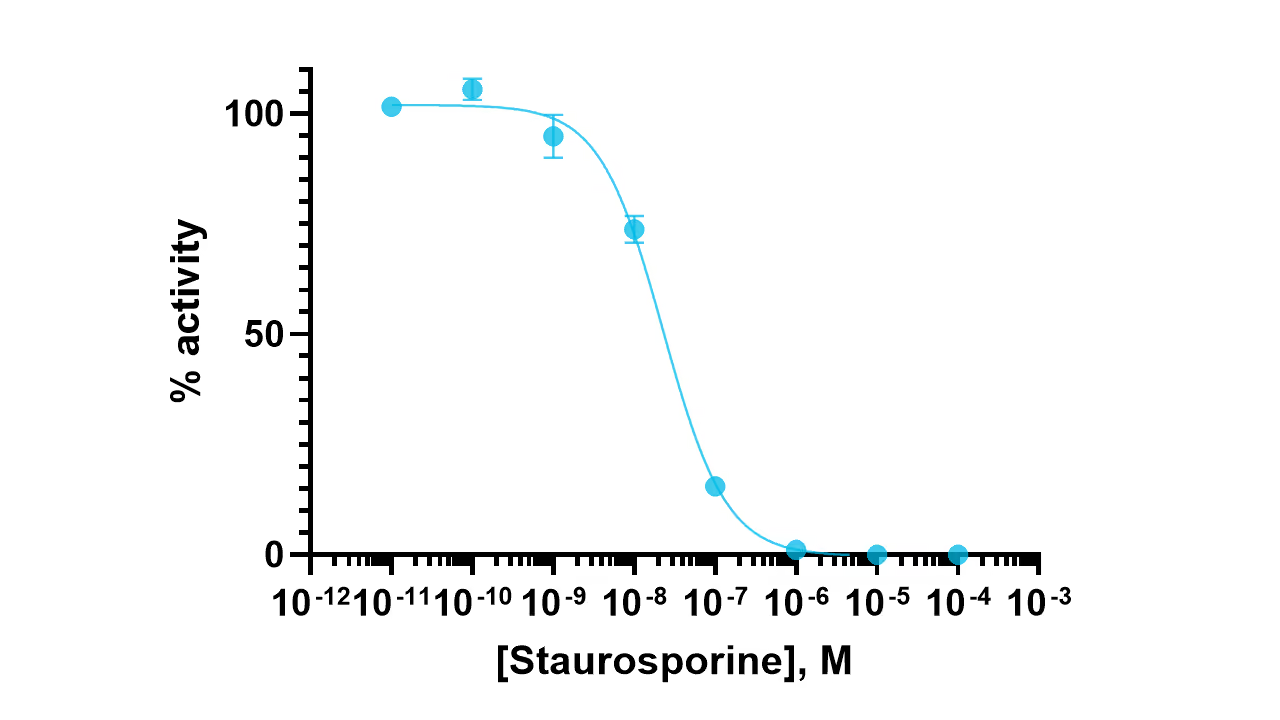
The Kinase Enzyme Activity Assay Kit provides a reliable biochemical method for evaluating kinase inhibitors. Built on HitHunter® assay technology, this kit is specifically optimized for LTK. It comes with all essential components, including recombinant LTK (Eurofins #14-958), a substrate, ATP, detection reagents, and assay plates. Each kit is accompanied by a Certificate of Analysis (COA), which outlines the recommended reaction conditions for accurate inhibitor detection. The supplied materials are sufficient to perform experiments covering two, six or twenty five 384-well assay plates.
LTK is a receptor tyrosine kinase belonging to the insulin receptor family. ALKAL1 or ALKAL2 ligand binding to the extracellular domain induces tyrosine kinase activation, leading to activation of the MAPK pathway. The precise cellular function of LTK is not known, however, studies with chimeric proteins demonstrate its ability to promote growth and cell survival. It has also been shown to be involved in regulation of the secretory pathway involving endoplasmic reticulum (ER) export sites and ER to Golgi transport. A CLIP1-LTK fusion has been identified as an oncogenic driver in non-small cell lung cancer (NSCLC). The fusion protein constitutively activates LTK and its downstream signaling molecules, including AKT and ERK4, resulting in cell proliferation and the suppression of apoptosis. More recently, LTK has been described as a therapeutic target in the biosynthetic pathway of proteostasis, with significant potential for multiple myeloma treatment.
Product specifications
Chemical data
The Kinase Enzyme Activity Assay Kit provides a reliable biochemical method for evaluating kinase inhibitors. Built on HitHunter® assay technology, this kit is specifically optimized for LTK. It comes with all essential components, including recombinant LTK (Eurofins #14-958), a substrate, ATP, detection reagents, and assay plates. Each kit is accompanied by a Certificate of Analysis (COA), which outlines the recommended reaction conditions for accurate inhibitor detection. The supplied materials are sufficient to perform experiments covering two, six or twenty five 384-well assay plates.
LTK is a receptor tyrosine kinase belonging to the insulin receptor family. ALKAL1 or ALKAL2 ligand binding to the extracellular domain induces tyrosine kinase activation, leading to activation of the MAPK pathway. The precise cellular function of LTK is not known, however, studies with chimeric proteins demonstrate its ability to promote growth and cell survival. It has also been shown to be involved in regulation of the secretory pathway involving endoplasmic reticulum (ER) export sites and ER to Golgi transport. A CLIP1-LTK fusion has been identified as an oncogenic driver in non-small cell lung cancer (NSCLC). The fusion protein constitutively activates LTK and its downstream signaling molecules, including AKT and ERK4, resulting in cell proliferation and the suppression of apoptosis. More recently, LTK has been described as a therapeutic target in the biosynthetic pathway of proteostasis, with significant potential for multiple myeloma treatment.
Product specifications
Kinase Activity Assay Biological information
The Kinase Enzyme Activity Assay Kit provides a reliable biochemical method for evaluating kinase inhibitors. Built on HitHunter® assay technology, this kit is specifically optimized for LTK. It comes with all essential components, including recombinant LTK (Eurofins #14-958), a substrate, ATP, detection reagents, and assay plates. Each kit is accompanied by a Certificate of Analysis (COA), which outlines the recommended reaction conditions for accurate inhibitor detection. The supplied materials are sufficient to perform experiments covering two, six or twenty five 384-well assay plates.
LTK is a receptor tyrosine kinase belonging to the insulin receptor family. ALKAL1 or ALKAL2 ligand binding to the extracellular domain induces tyrosine kinase activation, leading to activation of the MAPK pathway. The precise cellular function of LTK is not known, however, studies with chimeric proteins demonstrate its ability to promote growth and cell survival. It has also been shown to be involved in regulation of the secretory pathway involving endoplasmic reticulum (ER) export sites and ER to Golgi transport. A CLIP1-LTK fusion has been identified as an oncogenic driver in non-small cell lung cancer (NSCLC). The fusion protein constitutively activates LTK and its downstream signaling molecules, including AKT and ERK4, resulting in cell proliferation and the suppression of apoptosis. More recently, LTK has been described as a therapeutic target in the biosynthetic pathway of proteostasis, with significant potential for multiple myeloma treatment.
TYK1
Kinase Activity Assay Usage
For Research Use Only
Kinase Activity Assay Information
Biological Information
The Kinase Enzyme Activity Assay Kit provides a reliable biochemical method for evaluating kinase inhibitors. Built on HitHunter® assay technology, this kit is specifically optimized for LTK. It comes with all essential components, including recombinant LTK (Eurofins #14-958), a substrate, ATP, detection reagents, and assay plates. Each kit is accompanied by a Certificate of Analysis (COA), which outlines the recommended reaction conditions for accurate inhibitor detection. The supplied materials are sufficient to perform experiments covering two, six or twenty five 384-well assay plates.
LTK is a receptor tyrosine kinase belonging to the insulin receptor family. ALKAL1 or ALKAL2 ligand binding to the extracellular domain induces tyrosine kinase activation, leading to activation of the MAPK pathway. The precise cellular function of LTK is not known, however, studies with chimeric proteins demonstrate its ability to promote growth and cell survival. It has also been shown to be involved in regulation of the secretory pathway involving endoplasmic reticulum (ER) export sites and ER to Golgi transport. A CLIP1-LTK fusion has been identified as an oncogenic driver in non-small cell lung cancer (NSCLC). The fusion protein constitutively activates LTK and its downstream signaling molecules, including AKT and ERK4, resulting in cell proliferation and the suppression of apoptosis. More recently, LTK has been described as a therapeutic target in the biosynthetic pathway of proteostasis, with significant potential for multiple myeloma treatment.
Product Specifications
For Research Use Only
Biological Information
The Kinase Enzyme Activity Assay Kit provides a reliable biochemical method for evaluating kinase inhibitors. Built on HitHunter® assay technology, this kit is specifically optimized for LTK. It comes with all essential components, including recombinant LTK (Eurofins #14-958), a substrate, ATP, detection reagents, and assay plates. Each kit is accompanied by a Certificate of Analysis (COA), which outlines the recommended reaction conditions for accurate inhibitor detection. The supplied materials are sufficient to perform experiments covering two, six or twenty five 384-well assay plates.
LTK is a receptor tyrosine kinase belonging to the insulin receptor family. ALKAL1 or ALKAL2 ligand binding to the extracellular domain induces tyrosine kinase activation, leading to activation of the MAPK pathway. The precise cellular function of LTK is not known, however, studies with chimeric proteins demonstrate its ability to promote growth and cell survival. It has also been shown to be involved in regulation of the secretory pathway involving endoplasmic reticulum (ER) export sites and ER to Golgi transport. A CLIP1-LTK fusion has been identified as an oncogenic driver in non-small cell lung cancer (NSCLC). The fusion protein constitutively activates LTK and its downstream signaling molecules, including AKT and ERK4, resulting in cell proliferation and the suppression of apoptosis. More recently, LTK has been described as a therapeutic target in the biosynthetic pathway of proteostasis, with significant potential for multiple myeloma treatment.
Product Specifications
For Research Use Only

Eurofins CALIXAR’s approach allows to preserve the original structure and function of recombinant proteins (Kinases, Phosphatases, Ubiquitin, Epigenetic Proteins, GPCRs, Ion Channels, Transporters, Receptors, Anchors and Viral Proteins) providing solutions for pharmaceutical industries, biotechnology companies and academic teams to develop conformational antibodies, formulate new vaccines, carry out Structure Based Drug Discovery and/or HTS assays.